Disappear Here Circa 2009
From 2008-2012 this was the website for Disappear Here, an e magazine about music, fashion, and everything you love.
Content is from the site's archived pages.

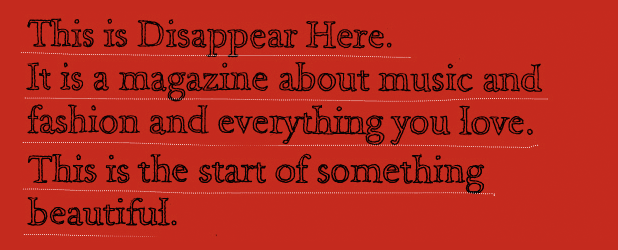

My discovery: It wasn't until I told my teenage college-age kids that I was planning a spring break vacation to Maui that I learned about the e-magazine, Disappear Here. My daughter was a devoted fan of this mag. The Maui trip was super cool, but I apparently was not because I had a completely different idea of what this website was about.
Around the same time, I was heavily involved in a community project that required managing a substantial amount of data. Given my growing concerns about digital privacy, I was re-evaluating the tools I was using, specifically Microsoft Access. While it had served me well, the shocking discovery about my friend's salary online had me questioning the security of the databases we commonly use. Because it will soon be unsupported, I began earnestly searching for a Microsoft Access replacement that would offer robust data protection.
My concerns about digital security peaked when I found out that my good friend, who works for the NYC government as an assistant district attorney in Queens, had his salary details exposed on govsalaries.com. When I searched for his name, "Benjamin Pred," the website popped up, revealing his earnings! As a privacy advocate, I was appalled. In a curious twist, when my kids first mentioned DisappearHereMag.com, I mistakenly thought it might be a privacy advocacy platform. Maybe they'd have insights on secure database solutions? Of course, I was way off base.
Despite my misinterpretations, I've come to appreciate DisappearHereMag.com for what it truly is: a great platform for the latest news and gossip on the music scene. But the journey there was definitely a lesson in the unexpected intersections of technology, privacy, and pop culture.
POSTS:
Mos Def - The Electric
Words by Max Feldman
hello@disappearheremag.com
It always feels as though Mos Def should be treated like an artiste. Occupying a space between the conserving of beloved hip-hop traditions and lighting some flair into our pre-existing knowledge of flow, he far transcends the platitudes of radio-friendly pop-hop. Like his contemporaries in Talib Kweli or The Roots, he clothes his rhymes in both consciousness and certain slickness. His Hollywood hindrances aside, The Ecstatic is a welcome return from an emcee almost too easily lost to unfulfilled promise. It not only signals some prodigal homecoming, but is exhales a sense of consideration for the conventions of album-craft – a trait that may soon vanish into pre-Beatles industry values.
Spells of invention cast cohesion between inherited techniques and the influences of modern gadgetry throughout the record: a Malcolm X sample and a searing guitar lead in the dazzling rush of opener ‘Supermagic’. This initial challenge continues throughout the following fifteen tracks. The Ecstatic sweeps a cerebral cinema back into hip-hop, recently masked by base techno beats and vocodered bleating. Instead, here we find an intercontinental clatter of Arabic influences and postmodern self-sampling on ‘Twilight Speedball’ and ‘Quiet Dog Bite Hard’, hinting at how uncomfortably high Tha Carter III has set contemporary standards.
Further still, Slick Rick’s guest spot and the orchestral bombast of ‘Life in Marvellous Times’ combine tradition and invention, homage and intellect, infusing a wholesome imagination to the clutter of this effort. Indeed, there’s a lot to listen to, and Mos sounds as confused by the current state of the game as we are. The most effective distillation of this sentiment, and the themes of the record, is found on ‘The Embassy’ where Mos challenges us with sounds and subjects ‘classic, modern, ancient, flagrant’. It all indicates an implied dread, a shifting auditory landscape that skips with jazz-limbed tension reflecting the disorientating mysteries of modern living- ‘Pretty Danger’, indeed.
Ultimately, The Ecstatic disappoints and enthrals in equal measure with a defiantly deliberate shrug. It’s not easily emulsified for consumer attitudes, dribbling for palatable pop precision. It requires attention, even a scholarly approach, to deal with verses that sound frustrated, struck from the page several times, or entire songs that feel unfinished; anxiously brief, prudently punkish. However, what they lack in length or focus is redeemed by the wealth of ideas that flutter in and out of earshot, a sonic superlative that twitters with contradictions- analogue ambition and digital dénouement.
Posted Thu, July 23, 2009
+++
Raygun! Raygun! RAYGUN!
Words by Sophie Eggleton
hello@disappearheremag.com
After completing my usual pre-gig research I can’t say I was overly thrilled at the prospect of trekking to the Boiler Room in Guildford with post roast lunch bloat on a lazy Sunday a few months back to see English rock/soul melodramatic popstars, Raygun. Finding that they had just come off supporting for Pink on her Funhouse tour, and played with The Script, I made unfair presumptions that they would be another bland, middle of the road pop-rock troupe. But I was very pleased to be proven wrong and found myself sashaying and singing to the songs upon first listen. With their flamboyant, snake hipped frontman with a suprsing voice that doesn’t seem to match his Nicholas Holt/Cillian Murphy hybrid looks, ridiculously catchy songs, and stage presence to boot, I predict big things for Raygun.
You recently played the Itunes festival, how did it go?
Really well! One of the best gigs we ever played! Lights were amazing!
You played Glastonbury and are playing V next. What’s different in performing at festivals rather than normal gigs? What do you prefer?
Bigger stage to fall off! Playing during the day is also fun as well. You also have the challenge of playing to a crowd who have no idea who you are – it keeps you on your toes, which is good.
Best show you have played?
Probably the one we played on the beach in Cannes. The whole beach was lit in neon pink, it looked like a cross between Miami Vice and a Duran Duran video. We were scheduled to go on immediately after a fireworks display so we were shitting it thinking “right we’re gonna have to be bigger than the fireworks”. In the end the whole place was dancing so we had a real laugh! It was definitely a moment.
How was it making the video for ‘Just Because’?
Best video we have ever made! Possibly the longest time we have ever spent in a car park. One of the best days of my life. It’s an over the top video for an over the top song. A performance on top of cars speeding down an LA freeway.
So when and how did you guys meet?
We all met in a Bavarian Disco. Actually we all met at the Dorchester hotel, me and Adj were having a spot of afternoon tea when we spotted the others on their way to the spa. We knew right then we had to be in a band together.
What are all your musical tastes?
A mixture of rock and roll and pop music. Love a bit of Timbaland, Grace Jones, The Rolling Stones and James Brown! Somehow with those influences it ended up sounding like us!
When you started playing together did a sound and genre emerge or was it something you discussed?
It was an organic process. Obviously there’s a certain amount of thought that goes into writing a song but it was never a pre-planned process. We went into the studio with some music and came out with songs.
You toured with Pink, how did that come about?
She picked us using tarot cards.
Did she offer any advice?
Have a lot of fun! And don’t smoke.
How do you find the touring experience, any fun stories?
Finding Sam spooning one of Pink’s male backing dancers! Only kidding! Actually heres’s a Raygun fact. The first line of the Just Because radio edit was recorded on that tour, in our hotel in Cologne. Room 206.
How do you ensure you don’t get sick of each other?
Laughter is always the best way to keep everyone happy. Arguing is also vital!
You seem to have mastered how to write the perfect catchy pop song, can you describe the writing process?
Well, we disagree about that but thank you for the compliment! We don’t really have a writing process, we just try and write good songs!
Are your songs taken from personal experience or more aimed at things that happen to everyone?
We often use personal experiences as inspiration for the songs but the key is to work the lyrics so that listeners can relate to them.
Ray, you seem very confident on stage, dancing and talking to the crowd. Are there any nerves?
Of course, I’m a bag of nerves before I go on, until I take my brave tablets!
What frontmen and women inspire you?
Tina Turner, Michael Jackson, Elvis and Freddie Mercury all inspire us greatly but we sound like none of them!
When I saw you live, there were hints of rather flamboyant tendencies. Is style important to you? Does that glam rock era inspire you?
Yeah style is very important, it’s something we’re very interested in. Karl Largerfeld is another great inspiration to me. He’s a cantankerous bitch like me!
Would you work with stylists or do you prefer to self style?
We are generally self styled but it is quite nice to have someone there with some nice new clothes. When we have had a stylist in the past Adj always ends up wearing his own clothes anyway!
Highlight of your career so far?
Playing at the O2 was an amazing experience for us, it was the last night of a pretty long tour and the show was just really special. Going to LA to shoot the video was pretty cool as well.
And a low point?
We don’t concentrate on low points so we don’t have one
How do you find the whole press aspect of being in a band, is it still exciting or is it laborious?
We’ve only just released our first single so there’s no way we find anything laborious or boring.
Does your impending fame scare you at all?
Fame is something you cant comprehend! We haven’t even thought about it yet.
Which one band was it that you heard that made you want to form this band?
The Clash, a proper London band! They were the complete package, amazing music and great style. A hugely versatile band. I met Mick Jones at a new years party once, he was a great character.
What’s the most awkward moment you’ve experienced in the band so far?
Playing in Chelsea Arts Club. We thought being an ‘arts club’ it was gonna be a cool place to play but as soon as we turned up and were setting up we got told off by the club chairman for looking at our mobile phones. Then we realized the clientele were a little older than we were used to – they were mostly in their 70s. We thought we were gonna get asked to leave for being too loud or something stupid like that so we started playing thinking ‘this won’t last long’. Oddly by the end the whole place was going nuts. Then it got even weirder, there was this 90 year old woman dancing with Ray while he sung the last song – it turned out she was Guy Ritchie’s grandmother!
And which band do you think we couldn’t live without?
I think it has to be the Beatles. They have touched so many people that we could never live without them.
Which one band do you think we could all live without?
The Illustrated Man – Mine and Adj’s first band. We can all live without that!
What are your hopes and dreams for the band?
We’d just love our music to evolve. We wanna be continually making records and playing it live. That’s who we are.
What is your mission statement as a band?
We have a few – Always Be Prepared. Never be late. Drink water. Ignore their pointing fingers and keep looking at the moon. Pleasure and Excitement! Take your pick!
One killer track of yours everyone should listen to?
I think it’s gotta be ‘Lord Forgive Me’. Love that song!
What are your hopes and dreams for the band?
We’d just love our music to evolve. We wanna be continually making records and playing it live. That’s who we are.
OK then, where do you see the band in five years’ time?
I’ll be dead by then, to be replaced by Paul Rogers!
Posted Wed, August 19, 2009
+++
Passion Pit
Words by Flic Wallace
hello@disappearheremag.com
As part of Levi’s Ones To Watch 5 Night Revue, Passion Pit topped off an evening of melodious, spangling pop goodness.
Fanfarlo proved to be a support band that you start by just watching and then end up being made to watch them. Through a torrent of different instruments, Fanfarlo provided tunes that appeared jaunty and off-kilter, whilst maintaining an aura of anthemic pop. As the last song broke down into a voice and melodica sea-shanty chant, Fanfarlo confirmed their status as ‘one to watch’.
Next up as one to have our eyes on, Passion Pit are already a band that have swiftly moved from songs that were singer Michael Angelakos’ home-made valentines gift to his girlfriend into a much hyped success story. Shortly after Angelakos’ friends helped him turn these songs into full band pieces, EP Chunk of Change, Passion Pit got themselves both a record deal and prestigious supporting roles with Girl Talk and Death Cab for Cutie.
Drummer Nate Donmoyer and keyboard player Ian Hultquist spoke to Disappear Here about this manic transition from hearing a songs a friend wrote in their bedroom, to becoming critically acclaimed as a band. With the release of new album Manners came the solidification of Passion Pit into a band, rather than just one persons songs. Despite the writing and recording process being rushed through in a manic space of months, Angelako’s now writes his music with the rest of the band in mind. Whereas before, Passion Pit had to spend a long time forming their parts and sounds around the pre-written gift of Chunk of Change, Manners was fully formed, five piece score – ready to go. And go it has, into a mammoth tour around the world, of which band members admitted Glastonbury was one of the highlights. Donmoyer and Hultquist have both been enjoying dappling in some DJ slots and remixing. Check out Passion Pit remix of The Yeah Yeah Yeahs, ‘Heads Will Roll’, for a juicy dance tune, utterly electronic with satisfying drops and stamped with the elated feel of Passion Pit.
And Passion Pit brought that elated, up-lifting vibe to the Levis show, hard to imagine that the dance, sing-a-long ‘Sleepyhead’ was originally only meant for one person to hear. The falcetto of Angelako’s voice compels him to almost force it out into the audience, providing a soaring sheen over the top of the pumping, bleeping melodies below. Passion Pit knew what they were doing tonight as they delivered tight performances, only the tiredness of a long schedule of this routine made tonight’s gig verge on the side of a band going through the motions. As Passion Pit have a remaining agenda of over 50 gigs and festivals to play this summer, lets hope there is enough passion left in these songs to sustain them.
Posted Thu, August 13, 2009
+++
Their Hearts Were Full of Spring!
Words by Tom Leins
hello@disappearheremag.com
‘How I Wasted My Youth’ is the debut album from sprawling London indie collective Their Hearts Were Full Of Spring. Since releasing their glorious debut single ‘A Question Of Trust’ back in 2007 the band have honed their wistful, shape-shifting indie pop into a potent, persuasive brew, and this self-assured thirteen-track collection represents the fruits of their labours.
Opening track ‘Take Your Own Good Advice’ is a delightfully woozy introduction to the band: an underwater love song that sounds like Sparklehorse and The Dears tussling over the contents of Spiritualized’s medicine cabinet!
With impeccable influences and an unfashionably elegant approach to song-craft, THWFOS are a formidable band who have built up a solid fan-base with an inventive array of seasonal cover versions. Happily, their own songs are more than capable of holding their own amongst such esteemed company, and this swooning debut record is a joyous treat.
For a ‘big’ band they eschew bombast in favour of a more languid approach, and their quirky methodology pays dividends throughout. Although previous reviews have drawn comparisons to US space cadets like Mercury Rev and Sparklehorse, THWFOS’ twinkling sound is firmly rooted in the British tradition, with clear nods to both Morrissey/The Smiths and 1970s psych-folk. Admittedly, there are occasional lapses into twee Britpop jangle, but for the most part the band have honed their dreamy pop blueprint to within an inch of its life.
In the post-Morrissey stakes they don’t quite surpass Canada’s extraordinary The Dears, but Their Hearts Were Full Of Spring have crafted a beguiling album full of happy-sounding sad songs and sad-sounding happy songs. They may have wasted their youth, but this wistful album is far from a waste of your time…
http://www.myspace.com/theirheartswerefullofspring
Posted Tue, August 18, 2009
+++
Girl Talk chat to Disappear Here
Words by Kristen Cochrane
hello@disappearheremag.com
“You do things at shows that don’t typically exist in a social setting. You’re in this foreign land.”
Stage diving. Confetti-filled bursting balloons. Frantic fan hysteria. Sex on stage? All formalities of a Girl Talk gig . Incidentally, the production behind Girl Talk mirrors the allegorical tale of a man robbing the rich to feed the poor, by sampling many enormously successful artists and creating sounds that could enthrall any musical palate. A man whose surrounding hype has had him devoured, adored, mauled and often abused by the media, under the alias Girl Talk (otherwise known as Gregg Gillis) chats to Disappear Here about juggling an engineering day job with weekend performances, his personal philosophy on copyright laws, as well as his self-proclamation of being a “hardcore nerd”.
You kept a cubicle job while performing shows on the weekends. Did your coworkers know about your double life? What was the beginning like?
Gregg : “They know now. I was about 22, 23 when I was working there, and they were all 35 and over. Now it would be easy to explain. I would be playing to fifteen people who hated it, I’m not being self-deprecating, but that’s what it was [laughs]. It was hard to explain, so I never wanted to try and define it to them. It was never something I expected to become a career. It was kind of like if you go to work and if you’re really into a specific nightlife, or any sort of subculture.”
What do you think of all the hysteria surrounding Girl Talk?
Gregg : “It’s very weird, [...] and I was kind of apprehensive about it. Right when it started to jump off, it was hard for me to stomach because I had been doing it for six years, and [then] certain websites review it, people are coming out to shows and you’re like ‘that’s great, but it’s also total bullshit that that’s what it takes for them to come out’. It took other people to say that it’s cool for them to get into it.
I specifically remember this first show I headlined at New York in the Mercury Lounge in 2006. It sold out and it was the only time I had ever played a headlining sold out show, with 200 people at the time. I don’t even remember the show right now, but I just read a review of it recently that was really negative, because I was kind of calling everyone losers and stuff [laughs], which I’m super embarrassed about. No one gave me a hard time, it was just hard for me to process [the attention].
It’s been growing steadily over the past three years and I just attribute that to six years experience, with people hating on you, and that builds up a certain level of confidence of being on stage. I almost feel sorry for these bands that blow up immediately and start playing these big shows, that’s got to be insane.
I was always playing shows to people who didn’t like it, so I would win over a few of them. And once I was playing to people who liked it, it was easy to win them over. So then I added people on stage for visuals, and people doing props. I’m super psyched to have the crew I have now.”
You throw insane parties that are of particular appeal to young people. What were you like in high school?
Gregg : “I was a hardcore nerd, I still am, absolutely, but back then I was super into the music. Maybe in 8th grade or so, after I heard Nirvana, [I thought] that band was weird. Even though they’re a total pop group, you just haven’t seen anything like that when you’re young. It’s just a weird alternative, and when I heard that, I just wanted to dive deeper into how weird the music can get.
By the time I was in high school, I discovered experimental music, where people were just using foot pedals and playing with a keyboard, and just performance art stuff, and that just blew my mind. It meant you could just get on stage and do anything. It was noise music. I just went to shows two or three times a week, that only fifteen people were attending, with weird noise bands and underground hiphop.
I was just kinda anti-social, you know, not hanging out, just doing this band thing, like recording on the four-track, and I started a tape label when I was in high school. I was just so involved in music, and the scene, and trying to wrap my head around every piece of music. I’ve never attended a high school party or anything. I threw shows at my parents house, and we had legitimate shows and the young band became a fixture in the Pittsburgh world.”
We hear a lot about copyrighting issues, with different positions from a lot of people. What is your personal stance on the issue?
Gregg : “I believe in copyright laws, I don’t necessarily believe in the bootlegging industry, and I think some people associate bootlegging with what I’m doing. I think it’s an isolated issue. Not because I feel morally obliged to it, but because I like buying cds. I still go to the record store and buy cds. I go to Best Buy about once a week and buy cds and stuff, probably more so than anyone else you know. It’s almost embarrassing how many cds I buy these days.
I feel that all music, all art, is derivative on something in the past, and you can’t make anything truly original, you have to have a certain basis. You see any band playing here today, and they have certain chord progressions, or notes, or lyrical themes, and it all comes from something before them, then they put their little spin on it and it becomes new.
You can hear any band and you say ‘it sounds like that mixed with that’ and I don’t think that’s a problem. They say ‘it’s ripping off something’, but everything sounds like something. If you were to wrap your head around any song you hear, you would be able to say that it’s based on something from before. That’s just the nature of music, and art, and everything has to be based on something.
I feel that with sampling, it’s easy to have a guitar, and a certain riff, and arrange the notes, write your own lyrics, speed it up, slow it down, and call it new. I feel there’s no reason with sampling, that you can’t take something that’s familiar and still recognizable and you can’t put it in another context.”
Sampling music promotes forgotten and obscure artists though, does it not?
Gregg : “I don’t see anyone buying my cd for a particular sample instead of the [original] song. I see more of the opposite. I get the emails everyday, asking what the sample is from a certain track. People are also really excited to have the wikipedia entry with all the sample listings.
The crowd is slightly younger, and a lot of people aren’t necessarily listening to James Taylor everyday, or listening to older music that I sample and that I like. I see it more as a promotional tool for [the original artists].”
Have any of these artists thanked you?
Gregg : “Yeah, I’ve never had a complaint thus far, but a handful of people have reached out, and not necessarily thanked me, but have said that they’re cool with what I’m doing. Sophie B. Hawkins, an artist from the nineties, mentioned in an interview that she’s cool with it, and that she was very excited about the way I used the sample and said it was reminiscent of the original way she wrote the song. Big Boi from Outkast came out to see a show in Atlanta when I played, and said that he had seen me before. Thurston Moore from Sonic Youth wasn’t even aware about it, and I told him that I sampled tracks, cut them up, and put them on the album, and he was fine with it. A lot of musicians right now that pay attention to this are open to a certain degree, because they’re used to putting out an album with people making remixes and songs on youtube. It’s not creating competition, it’s promoting it.”
What’s the strangest thing to have happened at a gig?
Gregg : “A lot of crazy stuff. People have had sex on stage. When I play at a club, it turns into a free-for-all. It’s crowded, and sometimes I can’t move. The stage and the audience is just one huge slope. So at a couple shows people have had sex, but not in a way where they were showing off on a table or anything, but they were caught up in the moment in the back, which I think is a lot more respectable if you’re caught up in the moment. That’s cool. I think if you’re having sex for the crowd it’s questionable, but I think if you’re doing your own thing, it’s fine.
I just think it’s a nice, extreme thing. People get nuts at shows, and jump on to other people. You do things at shows that don’t typically exist in a social setting. You’re in this foreign land. People jump on each other. You may have heard of it, it’s called crowdsurfing [laughs]. There’s all these crazy behaviours. Everyone stands in the same direction, bobbing their heads.
I don’t necessarily believe that anything goes, but you can’t think of having sex on stage, like…you’re at Subway, and people are [hypothetically] having sex in the corner. There are different social standards at a show.
I don’t want to promote that though, my mom would be upset.”
Posted Tue, August 25, 2009
+++
Offset Festival!
Words by Chris Harding
chris@disappearheremag.com
This weekend sees the return of our favourite artrock/electro festival. Offest is in its second year, but it’s already starting to attract an amazing lineup, with the Horrors headlining with their cosmic noise alongside the Slits and 70’s icon Damo Suzuki. And the Futureheads. And Danananakroyd. And Metronomy. There’s pretty much everything you’d ever need, what with these and 150 more bands.
In fact, there are exactly 24 bands playing that make me want to kiss whoever organised Offest, and considering it only costs £45 if you don’t camp and £55 if you do, I reckon that’s a pretty good deal - £1.88 per band. Anyway, I highly recommend heading down, and if you do, look out for me. I’ll be the one in a morph suit, covered in LEDs. It’s a new look for me, but I like it.
http://offsetfestival.co.uk/
Posted Thu, September 03, 2009
+++

I am excited about Highway
Words by Chris Harding
hello@disappearheremag.com
There’s a smell of synth in the air today. I can feel it in my bones.
Perhaps because French electrokids Fortune are on the verge of releasing their slinky debut single, Highway. It’s a very tidy little piece of electronic music, full of Stones Throw Record’s James Pants’ beats and hints of Chromeo and Neon Neon.
The three members of the band have a pretty excellent pedigree too, having connections to Cassius, Phoenix and even the likes of Sebastian Tellier. They’re playing around France for the next couple of months, so check out their myspace page for details if you happen to be making the hop across the channel. In fact, check their myspace anyway - their tunes are excellent.
http://www.myspace.com/ilovefortune
“Highway” by Fortune is released on November 9th.
Posted Mon, October 19, 2009
+++
Steve Aoki made some music
Words by Kristen Cochrane
hello@disappearheremag.com
“I just want him to pour Grey Goose in my mouth!” shouts a rather interesting female to my right, obvious hipster and slave to trends, hair imitating Billy Idol perfectly in the early ’80s, with the re-grown blonde locks somehow managing to maintain their heavily-hairsprayed position. Most are aware of such interactive tendencies, whether it be the near-toxic quantities of Grey Goose that Steve Aoki so generously pours into the thirsty mouths of fanboys and fangirls alike. Some are also aware that he has an incredibly attractive sister, who happens to be the world’s shortest supermodel.
These mundane details really don‘t matter though, when juxtaposed with Steve Aoki’s skills at mixing. His fanatical live performances are among the best in the electro-punk following. Many argue that the new generation of programmed backtracks is a sacrilege to music (instead of scratching), but Aoki compensates by pleasing his fans via stage diving, spraying expensive champagne into the crowd’s eyes and hair, and by simple gestured contact to fervent fans.
By the end of the set, he’s got his shirt off. His long, past-the-shoulder length hair flying wildly, he screams the best sequence of “Warp”, work of The Bloody Beetroots. He then moves on to possibly his most renowned track, the Weird Science remix of Bloc Party’s “Helicopter”, featuring the notorious Peaches. The crowd becomes turbulent and forms a mosh pit. The fervour in question could have been the result of the gig being on the same day as Canada’s national holiday, or it could equally have been the practiced talent of creating a well-intentioned riot amongst a copius group of people.
This Los Angeles dweller is not only musically gifted, but friends with a large clan of mainstream celebrities and obscure socialites. Most notably, him and Lindsay Lohan are tight. But before anyone can begin judging Steve for perhaps, living vicariously off of a wealthy family, it must be noted that he has not only founded Dim Mak records, and subsequently gathered a roster featuring Armand Van Helden, MSTRKRFT, The Bloody Beetroots, SHITDISCO, and Scanners, among others, but he holds a degree in Sociology and an additional degree in Women’s Studies from the University of California. Oh, and don’t forget his co-ownership of Korean BBQ restaurant Shin with Mark Ronson and Julian Casablancas of the Strokes fame. Entrepreneurial objectives aside, the guy throws a wicked party. But please, cover your eyes when you see him pull out the champagne : it, among any other liquid, is a stinging torpedo when it hits your retina. You have been warned.
Posted Mon, October 19, 2009